Sarah Packe: An 18th-Century Businesswoman
Sarah Packe was one of many businesswomen who confidently contributed to Williamsburg’s economic life in the eighteenth century. Like so many other people of her time, we only have a snapshot of Packe’s life. During her life, the social and economic positions of colonial women were gradually becoming more restrictive. Packe, however, illustrates how some women were able to push back against this tide, and continued to hold onto autonomy and power in their lives.1
Williamsburg’s Businesswomen
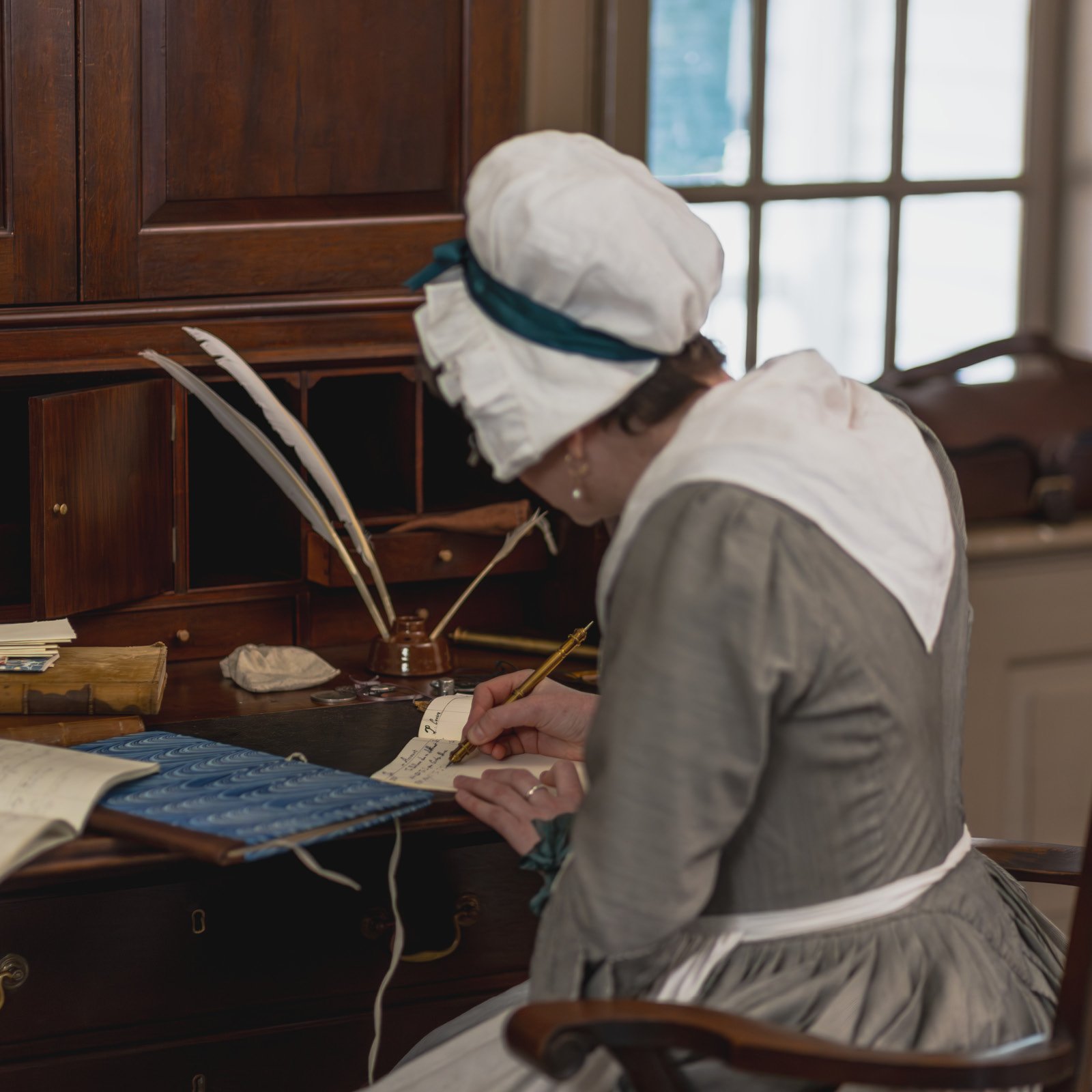
The stories of women in colonial America are sometimes difficult to recover. In Williamsburg, some women’s lives were documented more than others, giving future generations a glimpse into what the world was like for them, and others like them.


Clementina Rind
Learn about how one woman ran the Virginia Gazette, one of the most important newspapers in the colonies, and contributed to the American Revolution.
Jane Vobe
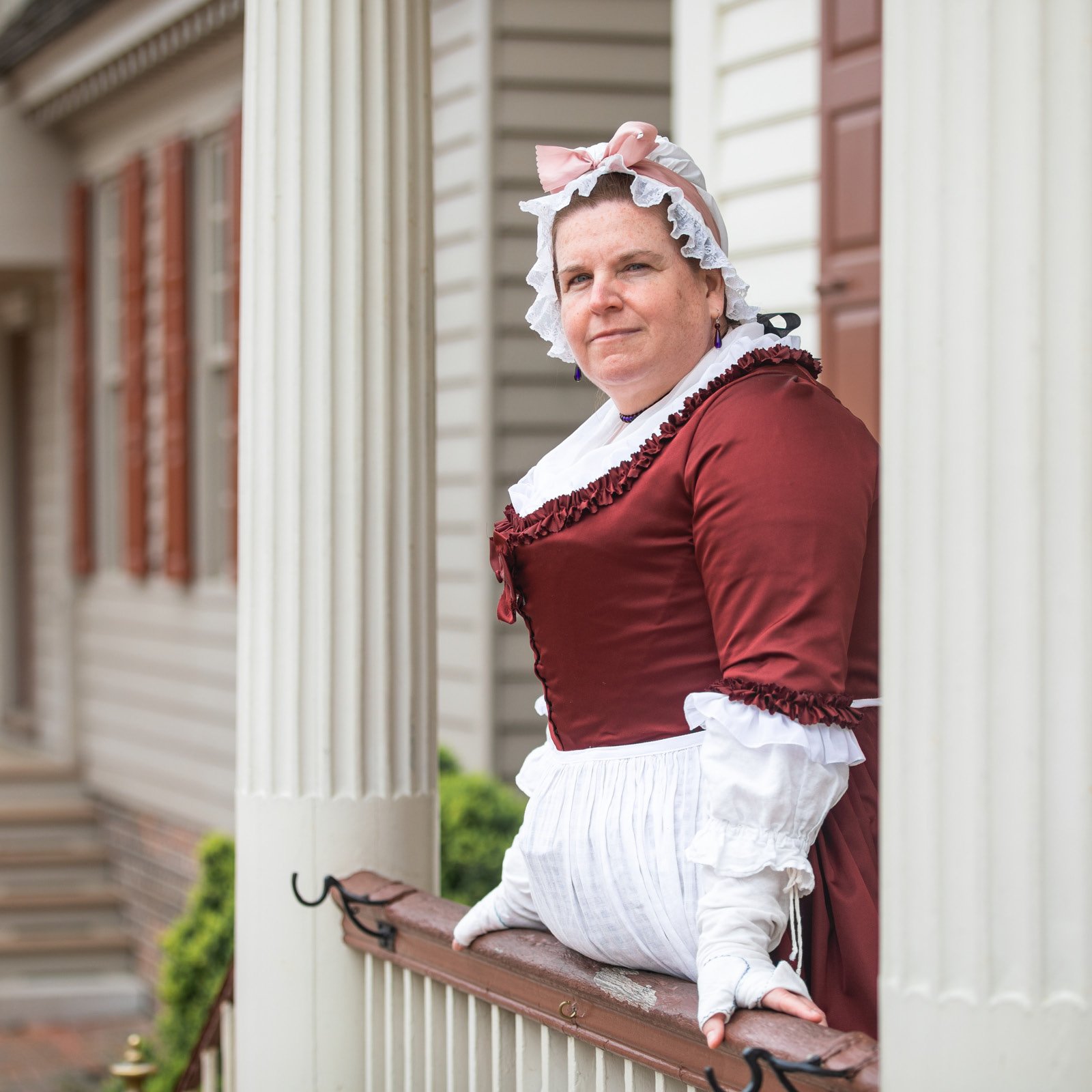
Jane Vobe was a tavern owner whose establishment was often frequented by Williamsburg’s more prominent residents. The scattered information that survives shows how some “middling” women ran taverns in colonial Virginia.
Christiana Campbell
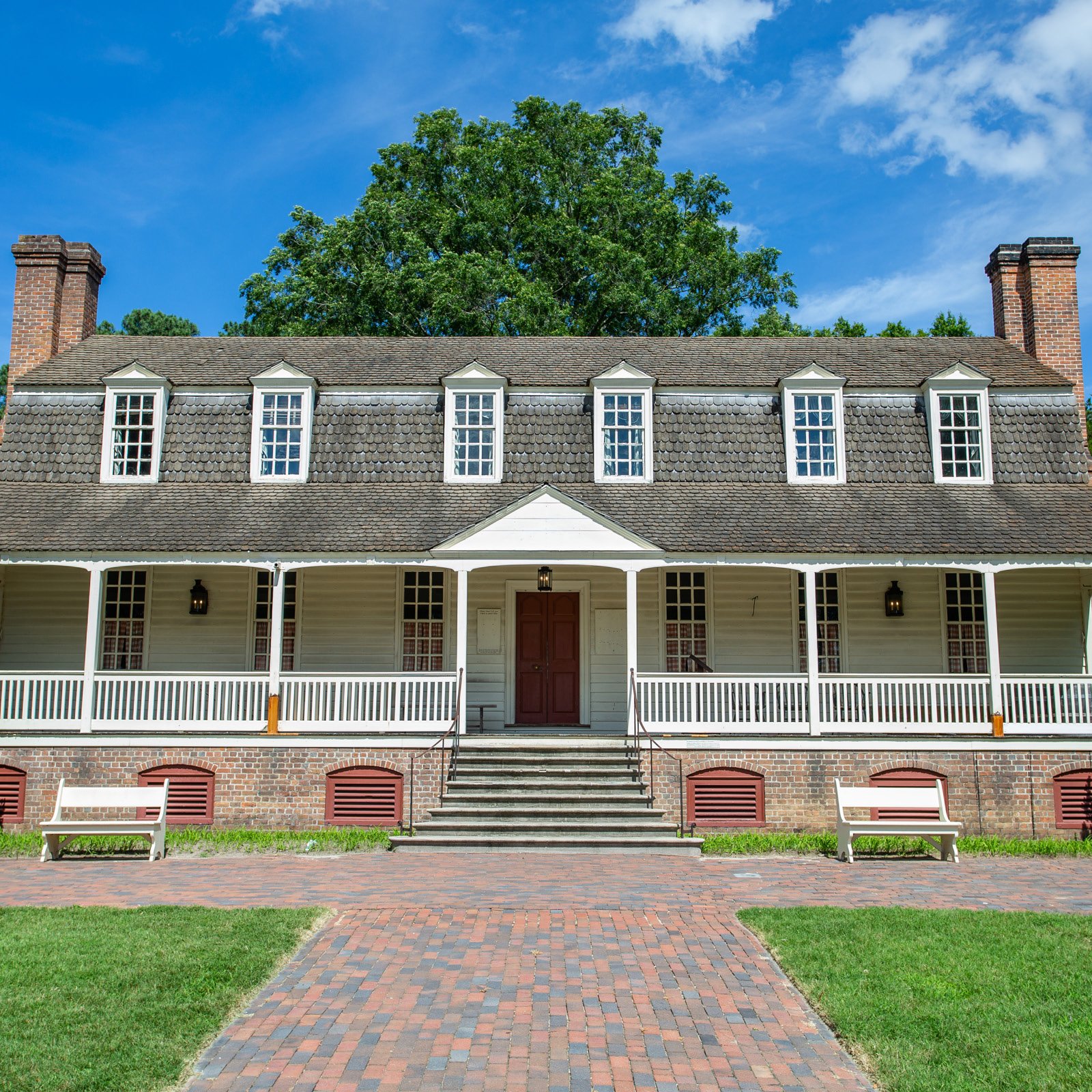
Running one of the colonial capital’s finest taverns, Christiana Campbell successfully managed her business for decades.

Margaret Hunter
Millinery was a woman-dominated trade, and Margaret Hunter ran a very successful shop in Virginia’s capital, providing a variety of goods and services to the city’s residents.
The Packe Family
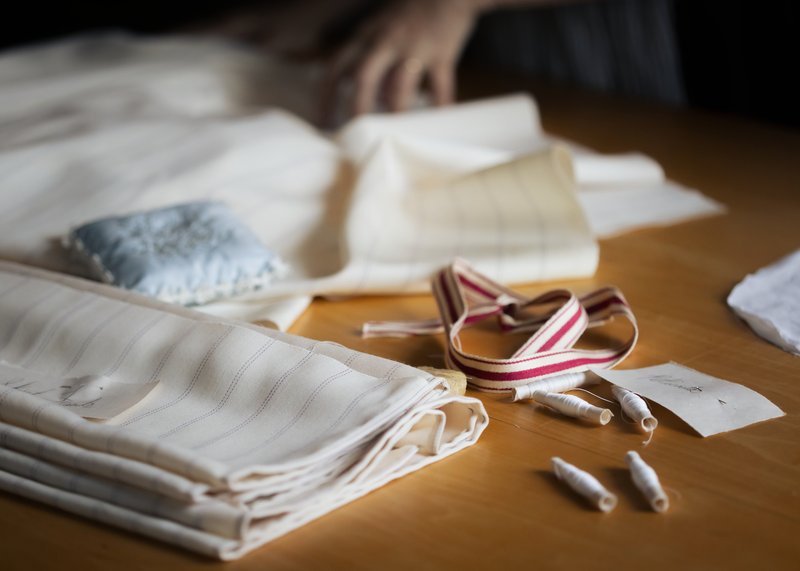
Living in Williamsburg, Sarah and Richard Packe married in the 1720s, and had three children: Bettey Jacqulin, Mary, and Graves. Bettey Jacqulin died in 1729. By 1731 Richard had died too. Following Richard’s death, church officials at Bruton Parish placed Mary in an apprenticeship with Joseph and Margaret Davenport to learn mantua-making, or dressmaking. Packe may not have had any role in this decision. Children of widows were sometimes legally declared orphans, and placed in others’ care, despite having a mother capable of supporting them.2
Widowhood
What role Packe may have played in her late-husband’s businesses during his life is unknown. Like many women of the time, she may have been actively involved in these businesses, which included watchmaking and silversmithing. What is certain, however, is that after his death, Packe was handling the businesses’ financial affairs.3
By 1732, records indicate she was not only suing in court to recover debts. She also served as executor of John Mayhew’s estate, who may have been a business associate of Richard. It was rare for a woman to be appointed as executor of an estate, and it illustrates the confidence the courts must have had in Packe to carry out the complicated task of inventorying a person’s property and keeping track of their debts.4
As a widow, Packe was now legally classified as a feme sole. Compared to married women, who were femmes coverts, femmes soles were legally independent, had the ability to buy, sell, and manage property, sue and be sued, and more. Women’s legal identity was entirely incorporated into their husbands’ when married, but widows like Packe were able to live, work, interact with the world around them without needing to be filtered through the men in their lives.5
New Ventures
Packe eventually moved on from her late husband’s businesses to pursue her own ventures. By 1737, she was actively cultivating business relationships with other Williamsburg residents and accepting lodging guests at her home. John Mercer, a well-known Virginia lawyer, advertised his services on multiple occasions when in Williamsburg for court sessions, directing people to find him at Packe’s residence. She continued to offer lodging into the 1740s.6
Packe also began selling various millinery goods. In March 1738 Packe placed an advertisement in the Virginia Gazette indicating that she had mourning attire available for ladies, and hatbands and gloves for gentlemen. Going into the 1740s, Packe continued to successfully cultivate business relationships and sell goods.7
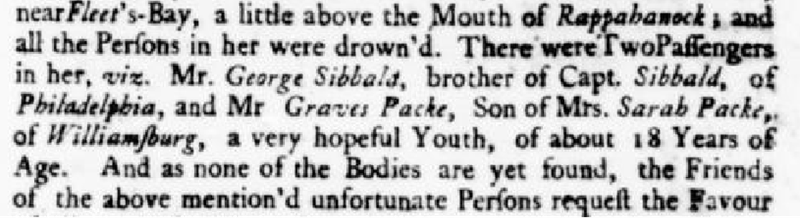
In 1745, Packe’s son, Graves, died in a shipwreck. The notice of his death included a brief request that anyone who found items belonging to him, or the other victim, return them. [8]
By the end of the 1740s, Packe had begun a new business partnership with William Parks, the founder and printer of the Virginia Gazette. Parks was an important member of the Williamsburg community, who had a variety of printing and non-printing business ventures, government contracts, and notable connections. What their partnership entailed isn’t completely known.9
However, in 1749, after a legal dispute between the two was dismissed in court, Parks and Packe entered into an agreement that detailed how debts and property would be handled in the event one of them died. Packe would receive £100 a year for five years, the use of Parks’s plantation, and three of his enslaved people if he died. In exchange, she agreed to discharge a large sum of the current debt owed to her. The document’s discussion of Park’s debts suggests at least part of their partnership included Packe selling the printer’s books. The agreement between the two came into effect the following year when Parks unexpectedly died while traveling to England.10
New Marriage
Over the next few years Packe was likely continued her business dealings. In 1754, she sold her home, a lot, furniture, life interest in Parks’s plantation, and debts owed to her to a local apothecary and surgeon named George Pitt.11
Unfortunately for Pitt, a series of events would lead to a years-long dispute over his agreement with Packe. Just after their agreement, Packe rented her shop to William Green and two of his associates. In the months that followed, she decided to marry Green. William subsequently announced in the Virginia Gazette that all debts owed to his wife were to be settled with him, and not Pitt.12
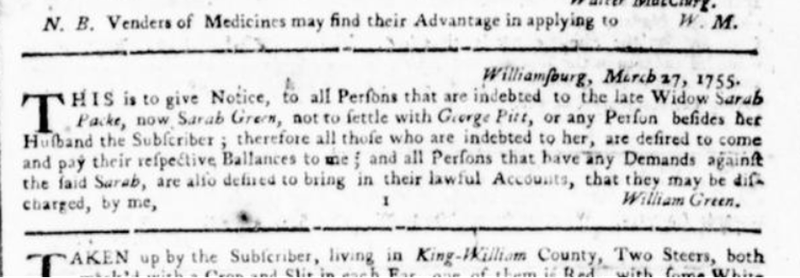
William Green’s attempt to circumvent the agreement Sarah Packe made with George Pitt would draw a sharp response from Pitt.
The notice flew in the face of the previous agreement between Pitt and Packe, now Sarah Green. Pitt quickly paid for two newspaper notices that attacked William Green’s actions, shared a rumor that he intended to move himself and Sarah to England after selling their property, and reasserted the terms of the existing agreement. Pitt finished by informing readers he would indemnify any person who made payments to him, and even offered a five percent discount to those who paid their debts by a certain point. No doubt, Pitt intended to undercut any incentive others may have had to deal with William, and not him.13
As the dispute between these two men continued, Sarah Green’s opinion on the disagreement is unknown. But while these two men went back and forth over the matter, it’s important to not lose sight of her. It was, after all, her property and debts that were at the center of this controversy. She had held onto and built this property through shrewd business acumen and steadfast commitment to holding others to their word.
Was she worried about losing everything she had built up? What did she think of her new husband going back on her word, especially considering she was all too willing to take others to court for breaking theirs? And what did she think of her inability to legally manage her own property affairs now that she was married for a second time?
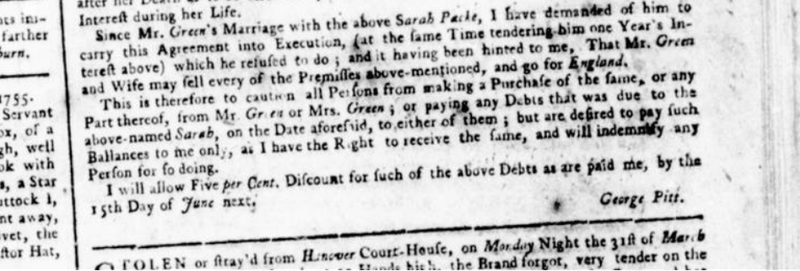
George Pitt published a notice in two issues of the Virginia Gazette detailing the deal struck between himself and Sarah Packe.
On April 22, 1757, Pitt put a notice in the Virginia Gazette that the home and lot “late belonging to Mrs. Pack” were to be put up for public auction at Wetherburn’s Tavern. She had likely died, though her death date is unknown. Pitt had succeeded against William Green in the property dispute, but the question of debts may have lingered, because Pitt continued to investigate Green, and eventually uncovered that Green was simply this man’s alias. His real name was William Barker, an English immigrant who regularly lied about being a merchant and had left a wife and son in Norwich after being convicted of bigamy.14
The controversy between Barker and Pitt, though it continued to play out after Sarah’s death, illustrates how important, but sometimes difficult, it was for colonial women to find suitable marriage prospects. The wrong choice could threaten everything they built and had in the world.
Sarah Packe’s life illustrates how some women were able to carve out a place within the growing colonial economy. She leveraged her property ownership and business partnerships to stake out a place for herself and her family.
Sources
- Linda L. Sturtz, Within Her Power: Propertied Women in Colonial Virginia (Routledge, 2002); Kathleen M. Brown, Good Wives, Nasty Wenches, and Anxious Patriarchs: Gender, Race, and Power in Colonial Virginia (University of North Carolina Press, 1996).
- Eleanor Kelley Cabell, Women Merchants and Milliners in Eighteenth Century Williamsburg (Colonial Williamsburg Foundation, 1990), 31; Helen Bullock, George Pitt House (LT) Historical Report, Block 18-2 Building 4B Lot 47 (Colonial Williamsburg Foundation, 1932), 4.
- Catherine B. Hollan, Virginia Silversmiths, Jewelers, Clock-and Watchmakers, 1607-1680 (Hollan Press, 2010), 518; Cabell, Women Merchants and Milliners in Eighteenth Century Williamsburg, 31.
- Hollan, Virginia Silversmiths, Jewelers, Clock-and Watchmakers, 1607-1680, 518; Cabell, Women Merchants and Milliners in Eighteenth Century Williamsburg, 31.
- Sturtz, Within Her Power, 20.
- Cabell, Women Merchants and Milliners in Eighteenth Century Williamsburg, 31; Virginia Gazette (Parks), June 17, 1737; Virginia Gazette (Parks), March 27, 1746, 4.
- Virginia Gazette (Parks), July 14, 1738, 4.
- Virginia Gazette (Parks), April 18, 1745, 3.
- Cabell, Women Merchants and Milliners in Eighteenth Century Williamsburg, 33; Mary A. Stephenson, George Pitt House (LT) Historical Report, Block 18-2 Building 48 (Colonial Williamsburg Foundation), 11.
- Stephenson, George Pitt House (LT) Historical Report, Block 18-2 Building 48, 11; Cabell, Women Merchants and Milliners in Eighteenth Century Williamsburg, 34.
- Cabell, Women Merchants and Milliners in Eighteenth Century Williamsburg, 35.
- Hollan, Virginia Silversmiths, Jewelers, Clock-and Watchmakers, 1607-1680, 583; Cabell, Women Merchants and Milliners in Eighteenth Century Williamsburg, 35; Virginia Gazette (Rind), March 28, 1755, 3.
- Virginia Gazette (Rind), April 11, 1755, 3; Virginia Gazette (Rind), April 18, 1755, 4.
- Virginia Gazette (Rind), April 22, 1757, 4; Stephenson, George Pitt House (LT) Historical Report, Block 18-2 Building 48, 13, 19; Hollan, Virginia Silversmiths, Jewelers, Clock-and Watchmakers, 1607-1680, 583.