“Under the King It Flourishes”
A silver belt plate belonged to a loyalist officer
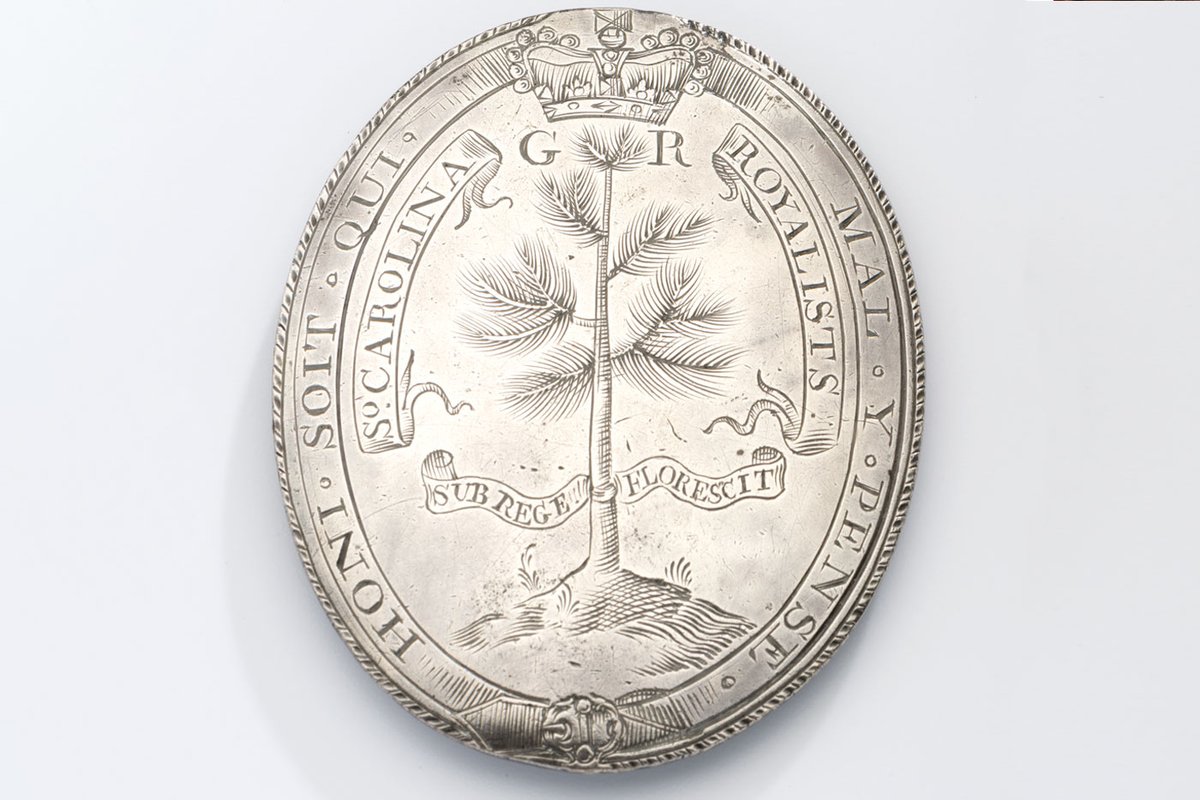
Precisely how many Americans remained loyal to England during the Revolution is difficult to know (most historians estimate 15% to 20% of the population), but loyalist sentiments were especially prevalent in parts of South Carolina. One measure of those sentiments was the nearly 5,000 men who fought for the British. One of these men, as an officer of the regiment known as the South Carolina Royalists, wore this small shoulder belt plate.
The South Carolina Royalists were formed in 1778 in Florida, where many loyalists from the Carolinas and Georgia had taken refuge. Loyalist forces played key roles when the British captured Savannah, Georgia, in December 1778, and Charleston, South Carolina, in May 1780. The South Carolina Royalists were present when Charleston fell and helped hold Savannah and the South Carolina town with the unusual name of Ninety Six. (The history of the name is not clear.)
“Efforts [were] made to raise other provincial units during the British occupation of South Carolina,” wrote historian Robert Stansbury Lambert, “but only the Royalists attained anything like its authorized strength for an extended period while the war lasted.”
After the war, some, like many other loyalists, moved to Canada.
The plate is the only known Southern example dating from the Revolutionary War. It was used as a buckle either on an officer’s bayonet belt or on a shoulder carriage for a sword. It is not known which officer it belonged to.
Engraved in an exquisite style in the middle of the piece is the Latin motto “sub rege florescit,” which translates to “Under the king it flourishes.” Around the edge is the Anglo-Norman maxim “honi soit qui mal y pense,” which means “Shame on anyone who thinks evil of it.” That phrase is also the motto of the British Order of the Garter, the most senior order of knighthood in Britain.
“It is the only known piece of Southern-made military silver from the Revolutionary War,” said Erik Goldstein, Colonial Williamsburg’s senior curator of mechanical arts, metals and numismatics, “and the motto and sapling pine tree under the royal crown are a perfect metaphor for the Southern loyalist movement.”
Previous owners of the plate did not realize its value. Before being listed in an online auction and acquired by Colonial Williamsburg, it was sold at a garage sale for just a few dollars.
About the Possible Maker
Thomas Coram was an engraver who worked in Charleston when the British occupied the city. He was known to have sought the business of military officers. In an advertisement in Charleston’s Royal Gazette, Coram offered “all kinds of engraved regimental and fancy buttons.”
More from this Issue