Rattlesnakes in the Rappahannock
How the Revolutionary War led to the colonization of Australia
William Murray, a smooth-talking shoplifter with a taste for gold and silver, usually got away with it. He would stroll into London’s grandest shops dressed like a gentleman, all polished shoes and well-cut coat. By the time clerks realized what had vanished — buckles, earrings, even the contents of the cash box — Murray was long gone. He practiced theft as performance, refining his script until, one day in 1773, when a jeweler recognized him on the street. This time, the law caught up with him.
He was sentenced to 14 years of hard labor across the Atlantic, a form of banishment called “transportation.” Shackled aboard the Justitia, Murray was one of 170 felons crammed into the ship’s hold on its voyage to Virginia. He was one of nearly 50,000 convicts shipped to America in the decades before the Revolution.
Convict Labor in America
Convict labor was central to Britain’s empire. European powers had long used felons as tools of colonization, from the Portuguese in Ceuta in North Africa to the Spanish in the Caribbean. England was no exception. As Richard Hakluyt had argued in an influential pamphlet back in 1584, why not put “pety theves” to work building forts and felling timber? By the early 1700s, thousands of them had already been banished across the Atlantic, their labor feeding Britain’s navy, mines and tobacco fields.
The practice grew after Parliament’s Transportation Act of 1718, which made exile to America the default punishment for crimes from poaching to forgery. Within a generation, transportation accounted for two-thirds of sentences at London’s Old Bailey. Most of those shipped out were young and poor. Some were serial offenders like William Murray, but the bulk were destitute strivers who had committed crimes of necessity. One woman sentenced to hard labor in the American colonies in 1771 had stolen nothing more than a basin of soup.
When the Justitia reached the Rappa-hannock River at the southern end of the Chesapeake Bay in March 1774, the captain and crew scrubbed the human cargo and advertised them for sale in the local press. Prospective buyers turned out in droves to poke and prod them and to pepper them with questions about their skills and strength. “They search us there as the dealers in horses do those animals in this country, by looking at our teeth, viewing our limbs, to see if they are sound and fit for their labour,” one remembered. Another recalled being asked “what vile Fact had brought Me to this Shore.”
All this scrutiny revealed potential purchasers’ ravenous appetite for convict labor, their insatiable demand a reflection of the fact that felons filled a crucial niche in the Chesapeake labor market. A convict like Murray cost about 25% more than an indentured servant. But his length of service was likely twice as long, and he cost just a third of the price of an enslaved man. They were long term, cheap and plentiful at a time when deliveries of indentured servants and captive Africans were often inconsistent and unreliable.
Contrary to myth, it was not Georgia but Virginia and Maryland that absorbed nearly 90% of Britain’s transported criminals. In Maryland, they accounted for nearly four in 10 new arrivals. A visitor to next-door Virginia in 1765 called their numbers there “amazing.” Buyers simply could not get enough. Even George Washington bought convicts, hiring them to marbleize Mount Vernon’s columns and renting others to till his fields. Male convicts became indispensable on farms and in forges and foundries, while women labored in domestic service.
The Case Against Criminal Labor
However, if many planters valued the convicts’ labor, a vocal chorus of other colonists despised their presence. Colonial critics of the convict trade charged that Britain was turning America into a dumping ground. Benjamin Franklin called them “human serpents” and suggested shipping rattlesnakes back in return. William Byrd II, never one to mince words, called them “Banditti” and begged correspondents in London “to hang up all your Felons at home, and not send them abroad to discredit their country in this manner.”
Byrd was not alone in worrying about crime or rebellion. Governors blamed arson and theft on “transported villains,” and Virginia’s assembly moved to tighten restrictions, barring convicts from land grants, stripping voting rights and eventually attaching hereditary servitude to children born during a convict mother’s term. That 1769 law, a transparent attempt to maximize the value of the woman’s labor contract by blurring the line between convict and slave, decreed that if “any convict servant woman shall be delivered of a bastard child, during the time of her service,” the convict’s master is “intitled to the service of such child, if a male until he shall arrive to the age of twenty-one years, if a female until she shall arrive to the age of eighteen years.”
By the 1760s and 1770s, opposition to transportation had become part of the broader quarrel with Britain. Franklin, John Dickinson and others denounced the practice as corrupting and insulting. Landon Carter, a planter who lived on the banks of the Rappahannock, complained of gaol fever, now known as typhus, spreading from ships.
Pamphleteers lumped in convicts with enslaved Africans as “glorious Importations of Corruption and Slavery.” Local assemblies tried to require ship captains to post bonds as security to allow convicts on shore and imposed various other restrictions. But London blocked every attempt, dismissing each effort as the usual colonial grumbling. For the Crown, transportation was humane, efficient and profitable. Samuel Johnson, a nationalistic English essayist, sneered that Americans were “a race of convicts” who should be grateful for anything short of the noose.
The convicts themselves were, of course, caught in the middle. Scorned and feared by some Chesapeake elites but readily bought and exploited by others, they complained of rations as meager as enslaved Africans’ and punishments just as severe. “I was very much discontented,” recalled Jesse Walden, sentenced to seven years of unpaid toil in Virginia. Robert Perkins, another transportee, said his work came with “all the Hardships that the Negro Slaves endured.”
Runaway Convicts
No wonder so many ran. Newspapers were filled with runaway ads describing the scars, accents and trades of those who had taken to their heels. Most fugitives were young men, but women, too, slipped away. Some tried for river ports, hoping to stow away on ships bound for home across the Atlantic. One owner reported that a woman named Mary Davis was “often inquiring whether many Vessels lay” at the Rappahannock.
Few escapees succeeded, and most who were caught paid dearly. A Maryland convict, William Green, explained the rule: “If we run away and are again taken, for every hour’s absence, we must serve [an extra] twenty-four, for a day, [we must serve an extra] week, for a week, [we must serve an extra] month, for a month, [we must serve an extra] year.”
Yet, true to form, William Murray, the silver-tongued jewelry thief, managed to beat the odds. In 1775, he slipped back to London after only 18 months abroad, having acquired an American accent and passed himself off as a loyalist refugee under the name William Jefferson. Soon he was back to his old tricks, stealing jewels and riding around town in a fine carriage. Justice again caught up with him in February 1776, however, when he was arrested for a second time, this time on suspicion of stealing a diamond ring.
Prosecutors quickly discovered his true identity, and the judge convicted Murray both for the theft and for violating his original sentence. He faced the usual penalty: banishment and hard labor. Ordinarily he would have been sent back across the Atlantic, but the blockades and embargoes in place since the outbreak of the Revolutionary War had closed the colonies to Britain’s felons. Instead of being banished, Murray was confined to Newgate, London’s already jam-packed central jail.
The Effects of the American Revolution
The American war abruptly severed the transportation system. Britain had relied on its Chesapeake colonies to absorb tens of thousands of convicts. Without them, the jails soon overflowed. Government ministers, reluctant to build new prisons, decided to improvise. They passed the Hulks Act of 1776, a piece of legislation that turned old, abandoned cargo ships languishing in Britain’s rivers and ports into floating jails.
Duncan Campbell, a London merchant who had once shipped thousands of convicts to Virginia and Maryland, now took the contract to manage hulks moored on the Thames — including the now worn-out Justitia, which had taken William Murray to the Rappahannock only three years earlier.
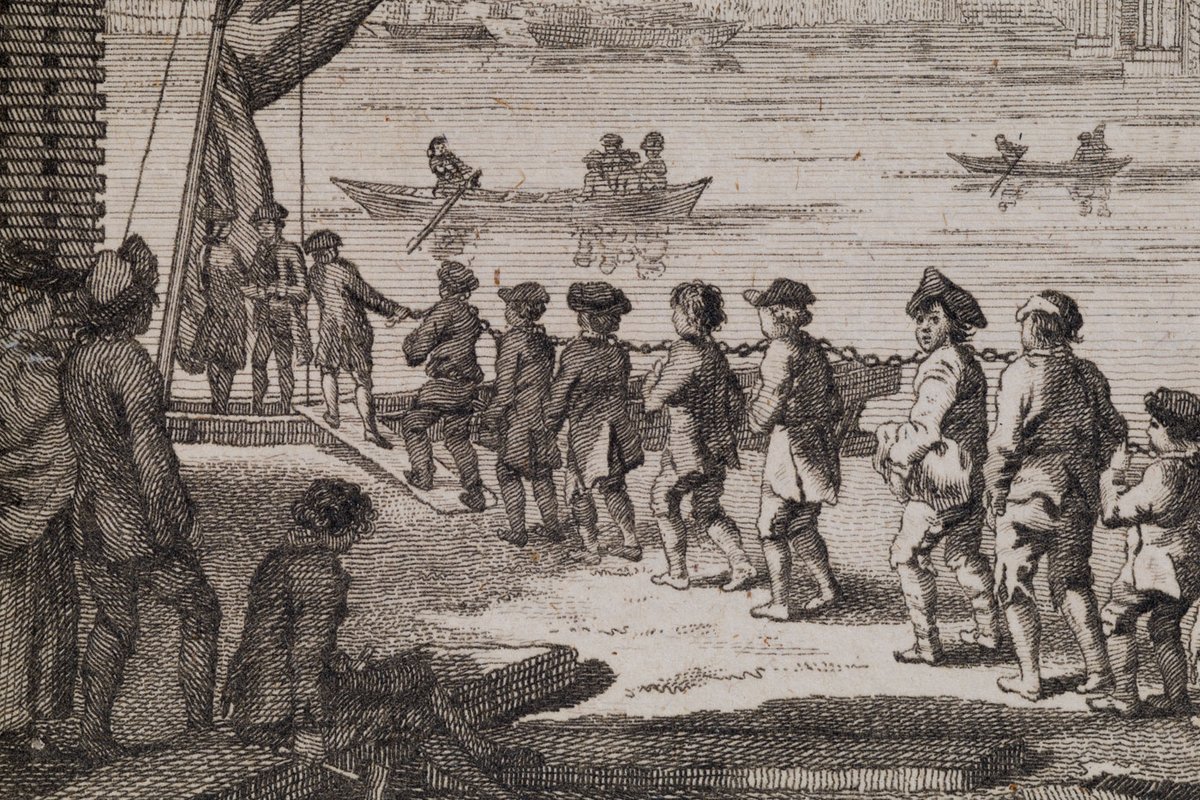
The conditions aboard these zombie ships were horrific. Prisoners slept chained in fetid hulls, rising each morning to haul and heave in the naval dockyards only to be chained back below decks each night. Disease — cholera, dysentery, smallpox — soon cut through their ranks. A quarter of the 2,000 men aboard Campbell’s hulks perished, their bodies cast into common graves at the river’s edge.
Parliament Burns
While Murray and others toiled in full-to-bursting jails and prison hulks, Britain was buckling under the strain of waging its great war in America. Trade collapsed, food prices soared and soldiers returned home to find no work. Petty thefts spiked, and the courts answered with gallows justice: Hangings in London quadrupled after 1780.
In June of that year, riots convulsed the city. Crowds of angry, unemployed Londoners torched Parliament and besieged Newgate, freeing the prisoners inside. One of them was William Murray, who would remain at large for nine days before being caught again.
Increasingly desperate, the British government tried all manner of stopgap schemes to restore public order. They even shipped some of the convicts, including William Murray, to West Africa to stand guard over Britain’s 13 undermanned slave forts. But sending Murray to Africa turned out to be a great mistake. Instead of knuckling down to guard duty, Murray talked his way into a command and then turned his garrison into a gang. Ultimately, his insubordination was so flagrant that the fort’s commanding officer ordered his execution.
Murray’s death symbolized the collapse of Britain’s bizarre convict-soldier experiment in Africa and hinted at its failures across the board. By now, the hulks in the Thames River were full and the jails were overflowing. Efforts to restart convict transportation to the Chesapeake in 1783 and 1784 were humiliatingly rebuffed. Everything the ministry tried failed, often spectacularly. By the mid-1780s, government ministers were frantic. “We are the only nation on earth,” one colonial agent in London lamented, “who seem not to know How to dispose of our Criminals.”
Britain Focuses on Australia
Lord Sydney, Britain’s home secretary, was at his wit’s end. With nowhere left to send convicts, on Aug. 18, 1786, he persuaded his fellow cabinet members to select a site in eastern Australia, reconnoitered by Capt. James Cook back in 1770, to host a brand-new penal colony. Lord Sydney’s plan was simple: Empty the hulks, quiet the streets and banish the problem to the ends of the earth.
The First Fleet sailed in 1787 carrying 1,500 people, the majority of them petty criminals — such as a boy caught stealing clothes, a woman who had nabbed bacon and raisins, and a man who had stolen cucumber plants.
The voyage marked the beginning of an 80-year experiment that would send more than 162,000 prisoners to Australia. The convicts once sold into Chesapeake fields and workshops now laid the foundations of another continent’s colonial history.
After the war, Congress barred further imports of British and Irish felons to the newly united states, denouncing the “injury [that] hath been done to the morals, as well as the health” of the country’s citizens. The Virginia legislature eagerly complied. And yet Virginia and other newly independent state legislatures subsequently moved to quietly adapt the logic of penal exile to punish enslaved rebels, deporting Black freedom fighters to Haiti or West Africa or selling them into the Deep South in the decades prior to the Civil War.
Over time, the practice was largely forgotten, barely a footnote in history. Despite that, the fact remains that tens of thousands of Britain’s criminals helped build the colonial Chesapeake. Forgotten, too, is how the sudden end of their forced migration helped give rise to Australia.
To tell the story of William Murray and his contemporaries is to recognize that such marginalized people were central actors in the story of empire and nation — allowing for a better understanding of the intertwined origins of America and Australia and the effect the Revolutionary War had on the entire world.
More from this Issue