Colorful Carrots
A vegetable to Root for
Whether it is diced for soup, shredded for a salad, peeled and cut for dipping or simply washed and eaten raw, the crunchy carrot has become a ubiquitous addition to everyday meals and snacks.
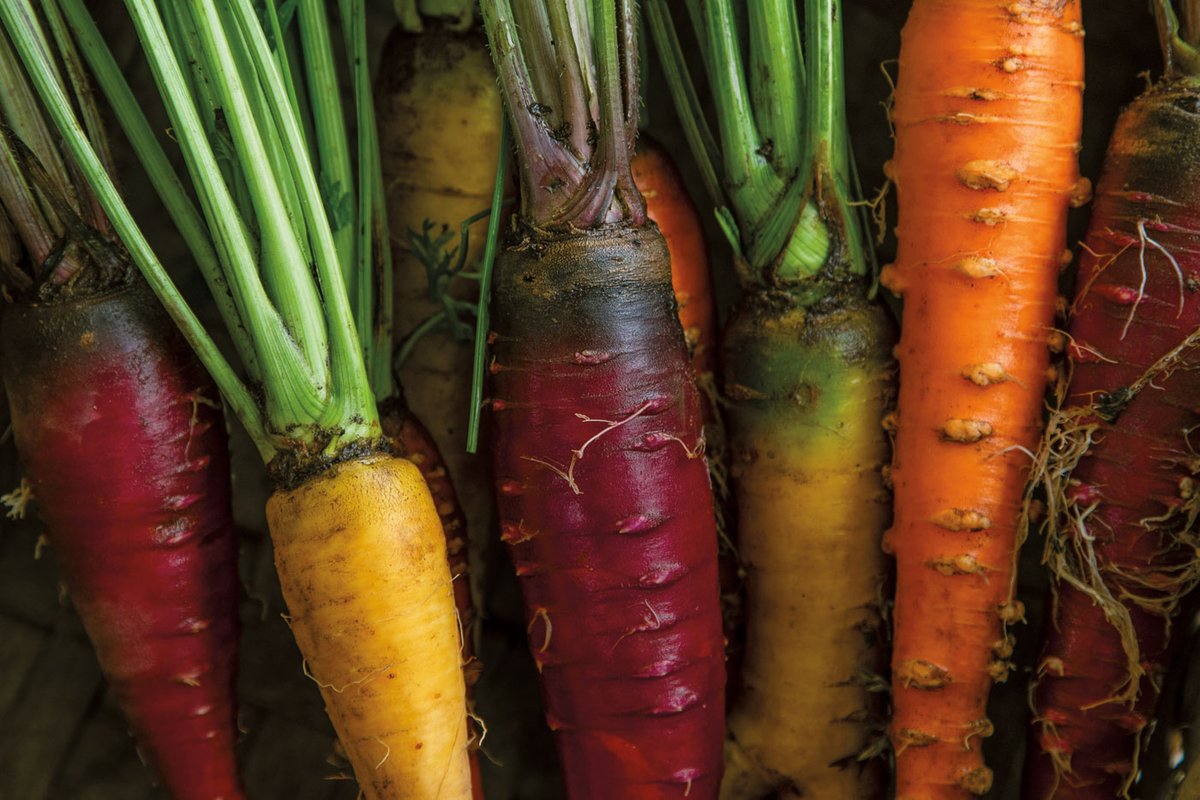
Today, the most common carrot is orange, but that was not always so. According to Wesley Greene, gardener and author of Vegetable Gardening: The Colonial Williamsburg Way, the first domesticated carrots, which originated in Afghanistan, were purple, but even purple carrots have an orange or yellow core. A yellow carrot, a mutant of the purple, was developed a bit later, probably in Turkey.
The first carrot introduced to Europe was the purple one, but by the end of the 16th century, the yellow one had replaced it in popularity. In the 17th century, the Dutch developed orange varieties. Modern orange carrots derive from the four varieties that were available by 1763. One short, blunt one, known as the scarlet horn, originated in the Dutch town of Hoorn. In colonial Virginia, the scarlet horn and the long orange were the preferred varieties.
Wild carrots, or Daucus carota, can still be found today. However, they have a woodier, more bitter taste. The National Institutes of Health also warns that wild carrots, commonly known as Queen Anne’s lace, bear a striking resemblance to hemlock, which is poisonous.
Carrots were introduced to Virginia by the first colonists. Alexander Whitaker’s 1613 Good Newes from Virginia made note of them. The Virginia Gazette published several mentions of carrots, along with other root vegetables, as early as 1759. John Carter’s store offered carrot seeds in an advertisement in December 1773, and James Wilson of William & Mary noted them in January 1774. In his 1793 Treatise on Gardening, John Randolph cited “two sorts, the orange and white,” noting that the white, which were developed by the French, were sweeter. Thomas Jefferson also mentioned carrots in his garden book in 1774.
“Carrots were important as a field crop as well as for human consumption,” said Eve Otmar, Colonial Williamsburg’s master of historic gardening. “Like turnips and other root vegetables, they were easy to grow and plentiful.”
Orange and yellow carrots in particular are rich in carotenoids. These pigments give carrots their color but also act as antioxidants in humans. Some vegetables are more nutritious cooked, and the carotenoids in carrots are a case in point: The body absorbs significantly more carotenoids when carrots are cooked. But there is plenty of nutrition in raw carrots as well.
“Carrots add wonderful color to the dinner table,” said Abbey Shoaf of Historic Foodways. Shoaf noted that carrots were grown in the Palace garden in the 18th century and, like many root vegetables, they stored very well in the cellar and could be enjoyed nearly year-round.
Historic Foodways presents a simple dish that may be used as a garnish for meats or served as a side.
“Carrots are very versatile,” said Julianne Gutierrez, executive chef at the Williamsburg Inn. “They can be packed in school lunches for a fresh, healthy treat, added to vegetable stock, enjoyed as an appetizer — and carrot cake is always a favorite dessert.”
Gutierrez likes to make honey-glazed carrots, roasted with a bit of paprika, ginger and curry for a tasty side dish.
She suggests selecting some of the more colorful varieties available today. “Purple, red and white carrots are prettier and a bit out of the ordinary,” she noted. No matter the color, be sure to select crisp, firm carrots. Her hummus appetizer is easy to prepare yet packed with plenty of flavor and nutrition.
Carrots Dressed the Dutch Way
Historic Foodways
Adapted from The Art of Cookery Made Plain and Easy by Hannah Glasse (London, 1747)
Serves 4–6
Ingredients
- 2 onions, chopped
- 6 carrots, thinly sliced
- 4 tablespoons butter
- Salt and pepper to taste
- 1 teaspoon parsley, chopped
Instructions
- In a saucepan, cover the onions and carrots with water.
- Add the butter, salt and pepper.
- Cover and cook for 15–20 minutes, until the carrots are tender.
- Strain off the water.
- Add the parsley and serve.
Carrot Hummus
Williamsburg Inn
Yields 2 cups
Ingredients
- 4 cloves garlic, peeled
- Canola, vegetable or olive oil (for roasting the garlic)
- 1 teaspoon smoked paprika
- 2 teaspoons curry powder
- ¼ teaspoon ground ginger
- 1½ cups chopped carrots
- 1¼ cups + 2 tablespoons vegetable oil, divided
- 1 15-ounce can chickpeas, rinsed and drained
- Kosher salt and freshly ground black pepper to taste
Instructions
- Roast the garlic: In a small saucepan, cover the garlic with oil. Starting with medium heat, bring the oil to a simmer, and then reduce the heat and cook the garlic until soft and golden brown, 10–15 minutes. Remove the garlic from the oil. Set aside.
- Preheat the oven to 400°F.
- In a large mixing bowl, combine the paprika, curry powder and ginger. Toss the carrots in 2 tablespoons of vegetable oil to coat and then toss them with the spice mixture.
- Spread the carrots on a baking sheet and roast in the oven until tender, 30–45 minutes, depending on the size of the carrots. Allow to cool.
- In a food processor, puree the roasted carrots, chickpeas and roasted garlic. Stream in 1¼ cups vegetable oil until combined. Season with salt and pepper.
- Serve with toasted pita chips, baguette slices or crackers of your choice.
More from this Issue