Changing of the Guard
New military programs debut — 250 years after the Revolution began
Colonial Williamsburg is renowned for showing how so many of the ideas that inspired the American Revolution came out of Virginia’s early capital. But the new nation was the result of battles as well as ideas, and a new initiative aims to tell those stories.
Re-creating an Army
Though Williamsburg was not the site of a major battle during the Revolutionary War, new regiments of soldiers gathered, trained and were clothed and equipped in town before marching off to war. One unit, the 2nd Virginia Regiment, was in Williamsburg from 1775 until early 1777.
“This is a site that saw a consistent military presence until the capital moved to Richmond in 1780,” said Sam McGinty, supervisor of military programs. “By thinking about who was here in Williamsburg day by day, we can tell a thoughtful story of Virginians during the Revolution.”
As with all Foundation programs, military ones are based on extensive research using primary documents, including correspondence and pension records. One key source is the orderly book of the 2nd Virginia Regiment, which served as the daily log of the orders and actions of the unit while they trained in Williamsburg. Also valuable are records of Virginia’s Public Store, a statewide warehouse
and supply system established in Williamsburg in 1775 to equip Virginia forces.
“The surviving records of the Public Store tell the robust story of the challenges of building and forming an American army, and the shifting aesthetics of a new American identity,” said McGinty. “They provide us with a road map for re-creating that army 250 years later.”
Many military programs take place near the town’s iconic Magazine, which is currently being restored to its 18th-century appearance. Others utilize the adjacent Guardhouse, which was reconstructed in 1935. According to the orderly book, the Guardhouse was used as a “laboratory,” a military term used at the time for a place where ammunition was produced.
“The Guardhouse offers a unique opportunity to explore this important, and perhaps first, patriot laboratory and its contribution to the American war effort,” said McGinty. Guests will be able to participate in hands-on activities such as cartridge rolling and mock gun-powder pouring. Guests will also encounter military interpreters exploring the many duties and skills of Revolutionary soldiers, including maintaining and repairing weapons, manufacturing cartridge boxes and other equipment, sewing uniforms, cooking and drilling.
Proudly Purple
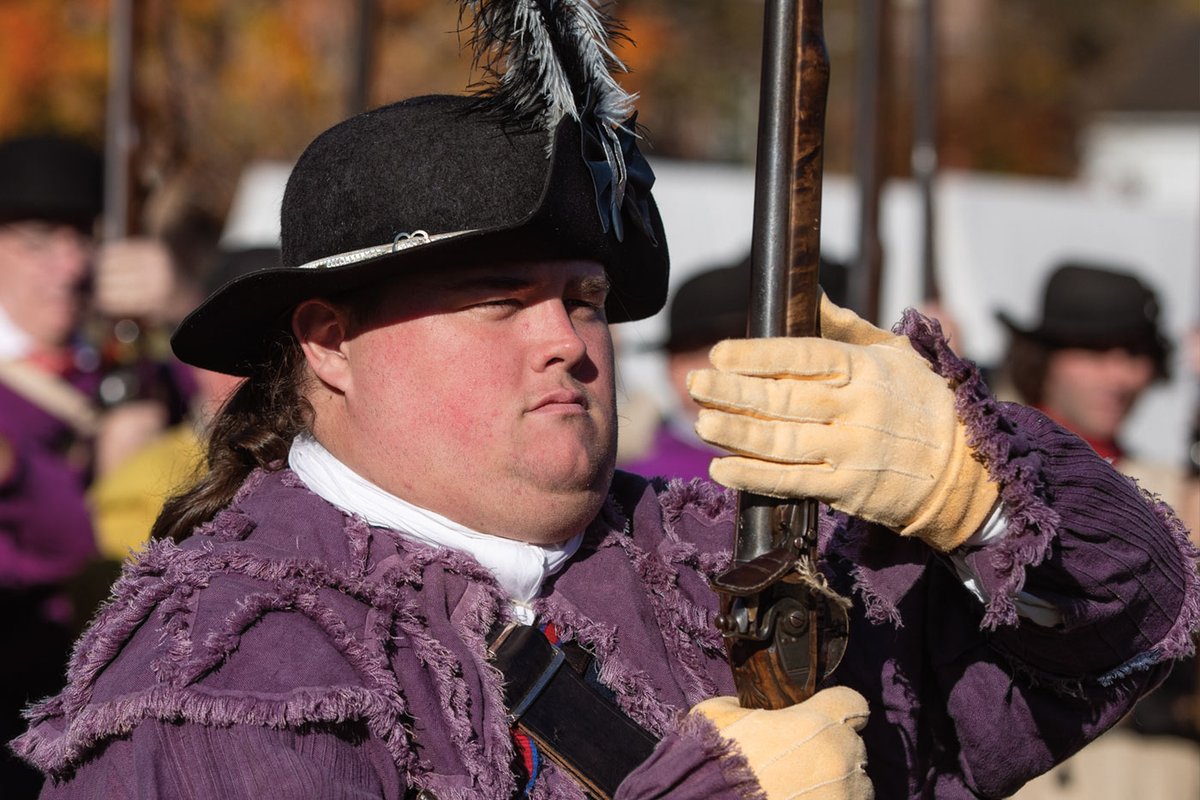
A special event highlighting the formation of the 2nd Virginia Regiment in Williamsburg 250 years ago took place Nov. 1–2 and welcomed more than 60 reenactors to help illustrate how Williamsburg prepared for war.
The orderly book called for “Officers and Soldiers to Spend one hour to day in Learning the Usual Exorcise and Evolutions.” So, in the mornings guests of all ages heeded the call to arms and joined the 2nd Virginia Regiment. They were briefed on the war and then trained to march and drill before being inspected by Capt. William Taliaferro, portrayed by McGinty.
At noon, guests experienced the heavy weight of liberty — in the form of artillery. In 1775, Capt. James Innes trained recruits to use these “great guns,” and in November guests joined interpreters as they hauled the guns into position on the Courthouse green. Guests also learned about loading and firing a cannon, followed by a firing demonstration.
Still drawing from the orderly book, which called for “Officers and Soldiers to Spend three hours in learning the Discipline of Woods fighting . . . as the most Likely method to make the Troops formidable to their Ennemies,” afternoon programs offered training in this tactic influenced by Indigenous American warfare of the 18th century. And just as the orderly book recorded that men “are always to fall in upon the Parade at Revelle Beating and Retreat Beating with their Arms & Ammunition,” the days concluded with a formal ceremony, followed by a march back toward their historic camp at William & Mary.
The 2nd Virginia wore hunting shirts, a uniquely American garment that was more like a jacket. The orderly book contains an order from Oct. 27, 1775, for the soldiers to dye their hunting shirts “of a purple Coulour,” presumably in an effort to give the soldiers a more uniform appearance. With that order in mind, Colonial Williamsburg’s weavers dyed hunting shirts purple for the military programs staff.
“We don’t know why purple,” McGinty said. “Maybe it was because brazilwood, a dyestuff used to make purple, was available and cheap. Or perhaps William Woodford, who commanded the 2nd, just really liked purple. Unfortunately, the reason seems to have been lost to history.”
The special event, called “Williamsburg Dy’d of a Purple Coulour,” included specialized work from many historic trades: The wheelwrights delivered a freshly painted cannon carriage, the foundry staff delivered freshly cast bullets, the printers delivered enlistment papers, the cooks explored differences between meals within the army to compare class and rank, and the farmers delivered fresh provisions to the soldiers.
“This multifaceted approach to telling the story of Williamsburg at war in 1775, utilizing our incredibly knowledgeable trades and skills, provided guests with a unique and dynamic look into the town’s past,” said Davis Tierney, senior manager of Historic Trades and Skills.
Future Programs
In 2026, military programs will highlight the two rifle companies of the 7th Virginia Regiment, which were composed of Virginia frontiersmen commanded by Capts. Joseph Crockett and Thomas Posey. Unlike British officers, whose commands were purchased and therefore tied to wealth and status, Virginia officers, like Crockett and Posey, rose through the ranks based on merit and skill.
Those portraying the riflemen of the 7th Virginia will be dressed in a mix of conventional military dress and
clothing influenced by their frontier background. The riflemen of the 7th saw action at the battles of Brandywine, Germantown and Saratoga.
Both Tierney and McGinty have extensive experience interpreting military history. They both were military interpreters for Colonial Williamsburg before leaving to work at other museums. McGinty returned to Colonial Williamsburg in 2024, followed by Tierney in 2025, to rebuild the Foundation’s military programming and to help organize special events tied to the 250th anniversary of the American Revolution.
“We are telling a broader story than just guys with guns,” McGinty said. “We have tried to be thoughtful of the humanity of the people we’re representing, rather than thinking of them as model soldiers on a board.”
The next special event, scheduled for the first weekend of May, will highlight the arrival of Crockett and Posey. Other events tied to pivotal moments in Virginia’s Revolutionary past will follow.
More from this Issue