The Independence Hurricane
In the late summer of 1775, a deadly hurricane battered the eastern seaboard of North America, wreaking havoc from North Carolina and Virginia all the way to Newfoundland. It killed thousands of people, mostly sailors, and destroyed many ships. Because it coincided with the outbreak of armed conflict in the American Revolution, the storm has become known as the Independence Hurricane.
The Winds of Providence
In the eighteenth century, hurricanes meant more than destruction—they seemed to speak for the heavens. Colonists widely understood weather, along with political events and supernatural occurrences, as signs from God. A revolution, earthquake, flood, or comet—all could be interpreted as signals of God’s pleasure or wrath.1
In 1775, Virginia stood on a precipice. The colony was divided into factions supporting and opposing the British government. The royal governor had recently fled Williamsburg, and the early stages of the Revolutionary War had already begun. The 1775 hurricane hit a divided Virginia with an uncertain future. For some, the hurricane appeared to show God’s repudiation of the revolutionary cause. But for others, the hurricane’s Loyalist victims showed whom God favored.2
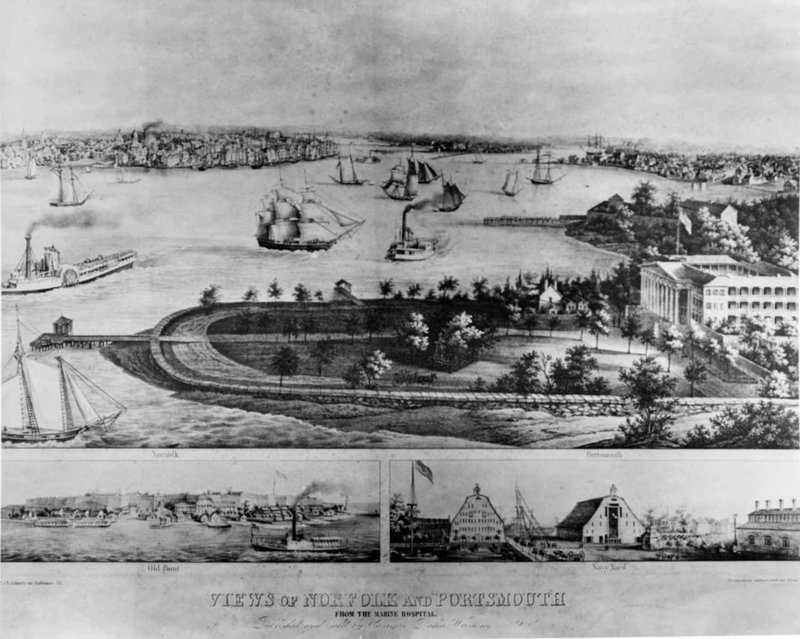
“Views of Norfolk and Portsmouth from the Marine Hospital,” 1851 lithograph.
Norfolk
The hurricane first struck North Carolina’s Outer Banks and the colonial capital New Bern and then hit Norfolk. As one of Virginia’s key tobacco ports, Norfolk had strong ties to Britain and a large Loyalist population. Sailors and those along the seashore were most affected. Ships were destroyed and a massive storm surge caused widespread flooding. When the storm hit on the afternoon of September 2, it stirred “one of the severest gales within the memory of man,” according to the local newspaper. Many sailors perished, and several ships were lost with their crews.3
For many Virginians, the storm could not have come at a worse time. At Virginia’s urging, the Continental Association had imposed a deadline of September 10 for exports to Britain, seeking to pressure the government to soften its colonial policies. When the storm hit, the Chesapeake was full of ships loading tobacco. The Norfolk newspaper observed that property damage was greater “as many vessels had taken on board part of their cargo . . . and would have been ready for sea before the tenth of this month.” After the hurricane, the Continental Congress offered exceptions for some merchants to export their goods after the deadline.4
Williamsburg and Plantations
Landlocked Williamsburg was spared the worst effects of the hurricane. But the town, and surrounding plantations, still endured heavy damage. The Virginia Gazette painted a picture of destruction: “Infinite damage has been done to the crops of corn and tobacco, much wheat spoiled in barns, a great number of trees blown down, and almost every mill-dam in the country given way.”5
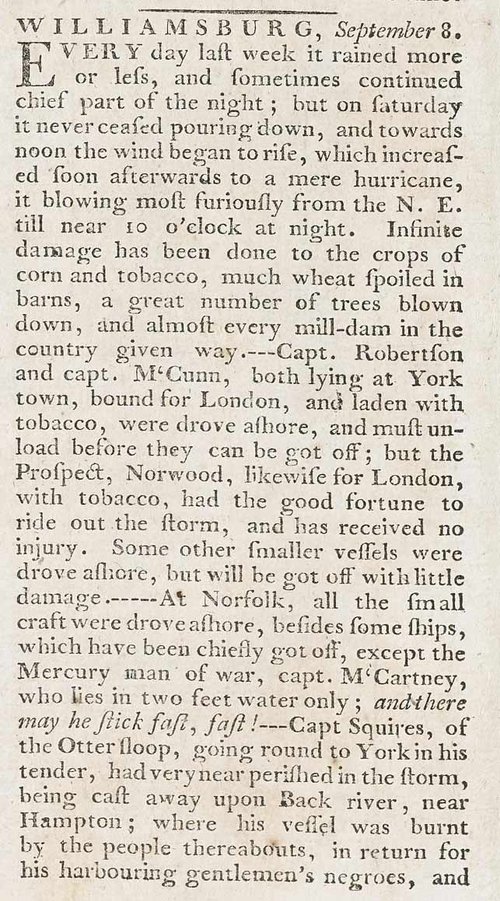
Virginia Gazette (Purdie), Sept. 7, 1775, p. 2.
Plantation owners surveyed their losses. Enslaver and planter Landon Carter recorded in his diary: “tobacco leaves all broke off and drove about, all the fences down everywhere.” Only his buildings, livestock, and enslaved laborers remained. The storm reminded him about how precarious wealth could be. When a man’s possessions could be lost so rapidly, “What can be his security as the value of his Possessions?”6
Virginia’s enslaved people likely faced the worst of the storm. Nearly half of the colony’s population was enslaved, and were forced to live in small, insecure, quarters that would have provided poor shelter from the storm. Even as the hurricane hit them hard, enslaved people were nonetheless tasked with cleanup and rebuilding across the colony. Their experiences with the hurricane and its aftermath, however, went largely unrecorded.
Carter provides scant references to the conditions enslaved people faced during this time. He noted the hurricane threatened his enslaved people’s food supplies (though he noted no concerns for his own supplies). And when the worst of the storm had passed, Carter immediately sent a group of enslaved men to repair his property’s mill dam, despite terrible rains continuing. Writing almost helplessly, Carter recorded that some became quite ill: “what chance do my poor [enslaved] people stand who have been all [the] while in the rain?”7
The hurricane also transformed the landscape of Williamsburg and beyond. Recent archaeological investigation of the site of the African Baptist Meeting House and Burial Ground has revealed that the lot’s swampy conditions resulted, in part, from the Independence Hurricane. The storm sent an enormous stream of water into the city’s ravines. On the lot that would later become the church’s home, the ravine failed to drain and became swampy. This was perhaps one reason that the First Baptist Church was able to obtain this land in the early nineteenth century: in its post-hurricane state, no one at the time valued the property very highly.8
The Otter Affair
The Independence Hurricane deepened revolutionary tensions. Several Royal Navy ships were damaged and grounded in shallow water.9 Rumors spread that Governor Dunmore, who had recently fled Williamsburg onto a Royal Navy vessel, had been tossed overboard during the hurricane. John Pinkney, a Williamsburg newspaper printer, added “But, according to the to the old saying, those who are born to be H[ange]d will never be Drowned.”10 This account may have been exaggerated or invented, by a Patriot writer eager to embarrass Dunmore.
Another incident involved Captain Matthew Squire of the Royal Navy ship, the Otter. Before the hurricane, colonists near Hampton Roads had been complaining about Squire harboring self-emancipated people aboard his ship.11 The wealthy enslaver Wilson Miles Cary believed that two men he enslaved, Aaron and Johnny, had liberated themselves and made their way aboard the Otter. When Cary searched the vessel, he later claimed that Squire hid Aaron and Johnny by taking them aboard a second vessel.12
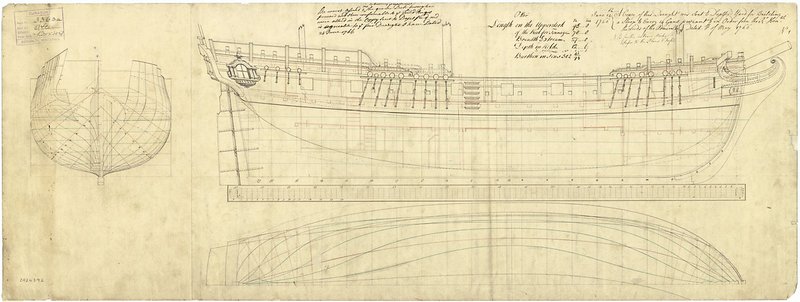
Technical drawing of HMS Otter (1767). Courtesy of the National Maritime Museum, Greenwich, London.
Then the hurricane struck. “Providentially,” wrote Cary, “during the gust,” a tender ship (a smaller, support ship) carrying Squire, as well as some of his crew including Aaron and Johnny, washed ashore.13 While Aaron, Johnny, and several other members of the crew were captured by local Patriots, Squire escaped. Another self-emancipated Black man, who was the Otter’s pilot, also managed to escape the wreck.14 Locals burned the ship.15
The incident alarmed Virginia’s enslavers. Just months before, rumors had spread that Governor Dunmore planned to arm and emancipate enslaved people. Now the hurricane had seemingly turned up evidence that the Royal Navy was indeed sheltering and employing enslaved people. The Virginia Gazette published three testimonies affirming this story.16 The Otter incident mobilized British and colonial opinion against each other. Only two months later, Dunmore issued his proclamation promising freedom to enslaved people who joined the army.
Conclusion
The Independence Hurricane struck at a moment of great uncertainty. With the war beginning, it was a fearsome portent. Had it been sent to warn against the revolution? Had it been sent to chastise Norfolk Loyalists or a haughty governor? Had it, as Cary suggested, been sent to return captured property and expose British deception?
In the eighteenth century, weather was Providence made visible. The Independence Hurricane became not only a storm, but also a symbol. In its destruction, it revealed the fragility of many things: property, social relations, and even the empire itself.
Sources
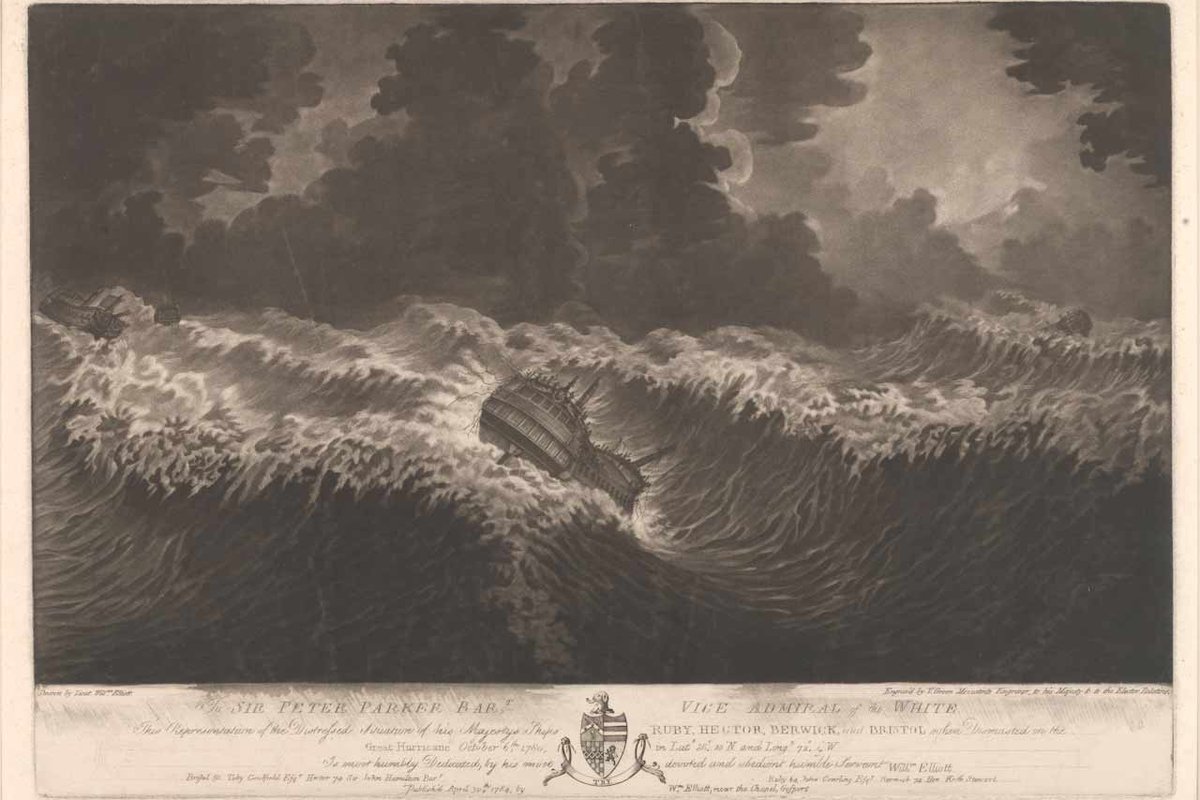
Cover image: Valentine Green and William Elliott, Representation of the Distressed Situation of His Majesty's Ships Ruby, Hector, Berwick and Bristol when Dismasted in the Great Hurricane October 6th 1780 (1784), National Maritime Museum.
- Kathleen S. Murphy, “Prodigies and Portents: Providentialism in the Eighteenth-Century Chesapeake,” Maryland Historical Magazine 97 (Winter, 2002): 397–421.
- Tony Williams, Hurricane of Independence: The Untold Story of the Deadly Storm at the Deciding Moment of the American Revolution (Sourcebooks, 2008).
- Williams, Hurricane of Independence, 32–35.
- Williams, Hurricane of Independence, 36.
- “Williamsburg,” Virginia Gazette (Purdie), Sept. 8, 1775, link.
- Landon Carter, The Diary of Colonel Landon Carter of Sabine Hall, 1752–1778, ed. Jack P. Greene (University Press of Virginia, 1965), 935–36.
- Carter, Diary of Colonel Landon Carter, 948.
- Interview with Jack Gary and Matthew Webster, “What’s New at First Baptist,” Colonial Williamsburg.
- “Williamsburg,” Virginia Gazette (Purdie), Sept. 8, 1775, page 2, link.
- “Williamsburg,” Virginia Gazette (Pinkney), Sept. 14, 1775, page 3, link.
- Robert Parkinson, The Common Cause: Creating Race and Nation in the American Revolution (Omohundro Institute, 2016), 143–44.
- Virginia Gazette (Purdie), Sept. 8, 1775, supplement, page 2, link.
- Virginia Gazette (Purdie), Sept. 8, 1775, supplement, page 2, link.
- “Williamsburg,” Virginia Gazette (Purdie), Sept. 8, 1775, page 2–3, link.
- “Williamsburg,” Virginia Gazette (Pinkney), Sept. 7, 1775, page 3, link.
- Virginia Gazette (Purdie), Sept. 8, 1775, supplement, page 2, link.
Keep History Alive!
Our donors help us achieve a deeper understanding of America's founding ideals and how they relate to the world and this country today. Because we are not state or federally funded, your support is crucial to preserving the wonder of Colonial Williamsburg. Give now to keep history alive for generations to come.